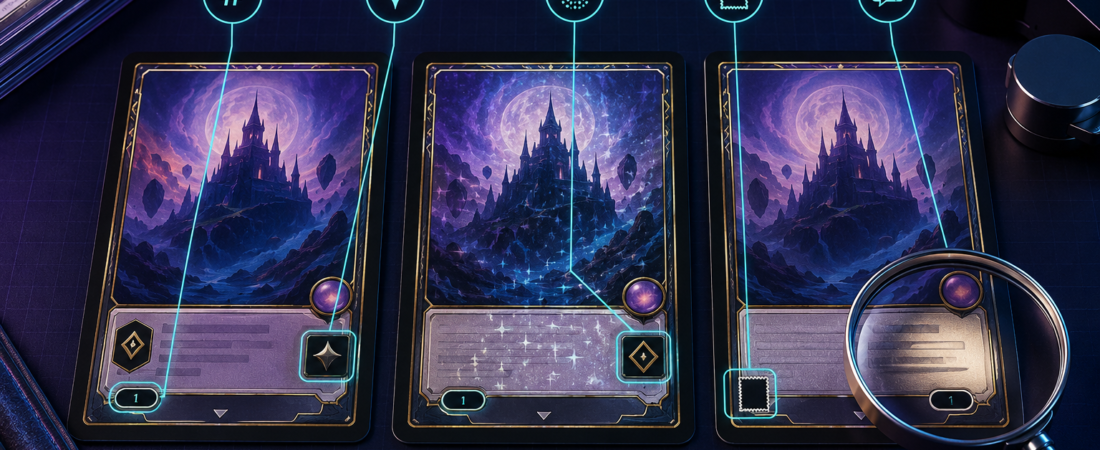
Learn how to identify the correct Pokémon card printing using its set, collector number, language, finish, edition and other distinguishing details.
Learning how to identify a Pokémon card printing is essential before checking its price. Cards with the same Pokémon name—or even similar artwork—may come from different sets, promotional releases, languages and foil variations.
Those differences can produce very different market values. Comparing the wrong printing may make an ordinary card appear unusually valuable or cause a genuinely scarce variation to be overlooked.
Accurate identification begins with the information printed on the card itself. The collector number, set details, language, finish and other characteristics work together to distinguish one printing from another.
Our beginner’s guide to how Pokémon card prices work explains why identifying the exact card is essential before relying on marketplace values.
Start with the card’s full name
The Pokémon’s name is the easiest detail to recognise, but it is only the beginning.
A single Pokémon can appear on hundreds of cards across different expansions, promotional releases and special products. Some cards may also share similar names while having different attacks, artwork or rules text.
Record the full name exactly as printed. This may include additions such as:
- ex
- EX
- GX
- V
- VMAX
- VSTAR
- BREAK
- Level-Up designations
- Owner or character names
- Regional or special forms
- Team or promotional identifiers
Capitalisation can matter because similar-looking designations may represent different eras or card mechanics.
Do not search only for “Charizard,” “Pikachu” or another character name and assume the first result is the correct card.
Find the collector number
The collector number is one of the most useful identification details.
It is usually printed near the bottom edge of the card and commonly appears in a format such as:
40/73
In this example, 40 is the card’s number within a set that contains 73 regularly numbered cards.
Collector numbers can help separate cards with similar names and artwork. Search using the name and collector number together whenever possible.
For example:
Shining Mew 40/73
is much more specific than searching for:
Mew card
Understanding numbers above the stated set total
Some cards have a collector number greater than the set’s stated total, such as:
75/73
These are commonly described as secret rares because their number extends beyond the regular set list.
A number above the set total can be an important identifying feature, but it does not automatically establish a high value. Demand, condition, artwork and availability still matter.
Also confirm that the numerator and denominator are both correct. Cards from separate sets can sometimes share the same individual card number.
Identify the set
A set is the group or expansion in which the card was released.
Depending on the card’s era, the set may be indicated by:
- A printed set symbol
- An expansion code
- A set abbreviation
- Copyright information
- A set name found by matching the collector number
- A promotional numbering system
Set symbols often appear near the collector number, rarity symbol or lower portion of the card. Their design and placement have changed across Pokémon card eras.
If you do not recognise the symbol, compare it with a reliable set list and confirm that the collector number belongs to the same set.
Do not identify a set using artwork alone. Similar or reused artwork may appear in another language, product or reprint.
Check the set code
Modern cards may display a short set code near the collector number.
The code can make identification easier because it provides a searchable abbreviation for the expansion. Combine it with the collector number when researching the card.
For example, a search containing:
- Card name
- Set code
- Collector number
will usually produce more accurate results than a name-only search.
Older cards may rely more heavily on set symbols and copyright dates, so the identification method depends on the card’s era.
Confirm the language
Language can affect both identification and market value.
Pokémon cards have been released in many languages, including:
- English
- Japanese
- German
- French
- Italian
- Spanish
- Portuguese
- Korean
- Chinese
- Indonesian
- Thai
Cards with similar artwork may have different numbering systems, set structures and release dates depending on their language.
Do not compare a Japanese card directly with an English card merely because the artwork looks the same. They may have different print quantities, rarity systems and collector demand.
When searching, include the language when it is not obvious from the marketplace or database.
Examine the copyright line and year
The copyright line near the bottom can provide clues about a card’s era or printing.
However, a printed year should not automatically be interpreted as the exact year the individual card was manufactured. It may relate to copyright information, the original artwork, the set or the legal text used for that release.
Some reprints retain similar artwork while updating copyright information or card formatting. Others may look nearly identical at a glance.
Use the year together with the set, collector number and other characteristics rather than relying on it alone.
Identify the card’s finish
Cards can be released with different surface finishes. These variations may share the same name, artwork and collector number while having different prices.
Common finish descriptions include:
- Non-holo
- Holofoil
- Reverse holofoil
- Parallel foil
- Cosmos holofoil
- Cracked-ice foil
- Stamped foil
- Promotional foil patterns
The terminology used by marketplaces and collectors may vary.
A traditional holofoil card usually has foil within the artwork area. A reverse holofoil generally applies a reflective pattern to other parts of the card while leaving the main artwork area different.
The exact appearance depends on the era and release. Examine the full front surface under angled light instead of relying on a flat photograph.
Holofoil and reverse-holo versions
Some sets include both regular and reverse-holo versions of many cards.
They may have the same collector number, making the finish essential for correct pricing. A marketplace may list each variation separately.
When comparing prices:
- Confirm where the foil appears.
- Look for patterns or set symbols in the reflective area.
- Check whether the marketplace labels the variation separately.
- Compare only with listings showing the same finish.
Photographs can sometimes hide foil effects. Ask for angled images when the listing description is unclear.
Promotional cards
Promotional cards are often identified through a separate numbering system rather than a standard expansion number.
They may be distributed through:
- Collection boxes
- Tournaments
- Retail promotions
- Magazines
- Movies or events
- League participation
- Special products
- Purchase bonuses
A promotional card may share artwork with a set card but include a promo symbol, stamp or different collector number.
Do not assume that every card distributed outside a booster pack is rare. Some promotional cards were widely available, while others had limited distribution.
Stamped cards
A stamp can identify a special release or variation.
Possible stamps include:
- Set logos
- Event names
- League identifiers
- Prerelease markings
- Product logos
- Anniversary markings
- Staff designations
- Championship identifiers
The stamp may substantially affect collectability when it represents a recognised and scarce release.
However, cards can also be altered with unofficial stamps. Compare placement, size, colour and printing quality with verified examples.
First Edition and unlimited printings
Some older Pokémon cards were issued in different print runs, including First Edition and unlimited versions.
A First Edition card generally includes a specific edition stamp in a recognised position. The presence, absence and appearance of that stamp must be examined carefully because counterfeit or added stamps exist.
Do not identify a card as First Edition based only on its age or artwork.
Other printing differences may include:
- Shadow or border variations
- Copyright-line differences
- Colour changes
- Text corrections
- Printing-location differences
- Symbol or layout changes
The importance of these characteristics depends on the particular set and card.
Shadowless and other early-printing differences
Some early English cards have recognised design differences that collectors use to distinguish printings.
These may involve:
- The presence or absence of a shadow around the artwork frame
- Different copyright text
- Colour saturation
- Font or layout variations
- Edition stamps
These terms apply to specific releases and should not be used broadly for every older card.
When identifying an early card, compare it with a detailed reference for that exact set rather than relying on a single characteristic.
Reprints and alternate releases
A card may be reprinted with the same or similar artwork in another set or product.
The reprint may have:
- A new collector number
- A different set symbol
- Updated rules text
- Different copyright information
- A new holofoil pattern
- A promotional stamp
- A different rarity
- Changed card borders or layout
Small differences can indicate a separate printing with its own market history.
Always verify the bottom details, not just the central artwork.
Artwork variations
Some cards with the same gameplay information are available with different artwork.
These may be described using terms such as:
- Full art
- Alternate art
- Illustration rare
- Special illustration rare
- Rainbow or hyper rare
- Gold card
- Secret rare
- Promotional art
Marketplace terminology can vary, and collectors may use informal names. The collector number is usually the safest way to distinguish them.
An artwork variation should be treated as a separate card for price comparison purposes.
Rarity symbols and rarity labels
Rarity indicators can help identify a card but should not be used alone.
Older cards may use symbols such as circles, diamonds or stars. Newer sets can use written rarity labels, multiple stars or other classification systems.
Rarity systems have changed over time and may differ between languages.
A rarity symbol describes the card’s classification within its release. It does not guarantee a particular market value. Popularity, condition, artwork and supply remain important.
Regional printings
Cards released for different markets can have subtle production differences even when they are in the same language.
Possible differences include:
- Copyright text
- Printing quality
- Card stock
- Colour saturation
- Packaging source
- Distribution method
- Factory markings
Some regional variations are well documented and collected. Others may simply reflect ordinary production differences.
Do not claim a rare regional variation without comparing the card with credible references and confirmed examples.
Error cards and corrected printings
An error card contains a recognised printing mistake. A corrected printing may later change the affected text, image or symbol.
Possible errors include:
- Misspelled words
- Incorrect attack information
- Missing symbols
- Wrong images
- Colour or layer errors
- Misaligned printing
- Incorrect numbering
Not every manufacturing defect is a recognised error variation. Minor ink spots, rough cuts and ordinary misprints may be condition or quality issues rather than separately catalogued cards.
A recognised error usually has consistent examples and documentation showing that multiple copies were released with the same mistake.
Misprints and miscuts
Miscuts, alignment errors and unusual print defects can attract specialist collectors.
Examples include:
- Off-centre cuts showing part of another card
- Missing ink layers
- Registration errors
- Obstruction marks
- Severe colour shifts
- Square or unusually shaped corners
The value of a misprint depends on its severity, authenticity and collector demand. A poorly centred card is not automatically a valuable miscut.
Authentication may be especially important when an unusual defect could have been created after production.
Confirm the card’s back
The back can help identify language, authenticity and condition.
Japanese cards and many international releases may have different back designs depending on their era. Counterfeit cards may also show incorrect colours, borders, fonts or printing quality.
Examine:
- Colour
- Border width
- Print sharpness
- Surface texture
- Alignment
- Damage
- Signs of alteration
Do not use one visual test as definitive proof of authenticity. Genuine production can vary, and sophisticated counterfeits may reproduce individual features.
Check whether the card is part of a special product
Some cards are distributed through decks, tins, boxes, collection sets or other products.
These releases may differ from booster-pack versions through:
- Holofoil pattern
- Stamps
- Set numbering
- Artwork
- Promotional symbols
- Finish
- Packaging-exclusive identifiers
The product source can help explain why a card looks different from a standard set listing.
If you still have the original packaging, retain photographs or records because they may assist identification.
Be cautious with marketplace titles
Seller titles are not always accurate.
A listing may use popular search terms such as “rare,” “vintage,” “first edition,” “shadowless” or “error” even when the card does not meet those descriptions.
Verify the card using photographs and printed details rather than trusting the title alone.
Also check whether the listing includes:
- One card or several
- A genuine card or reproduction
- A graded or ungraded copy
- The exact card pictured
- A foreign-language version
- A proxy or custom card
- A digital item rather than a physical card
A step-by-step identification process
Use this process when identifying a card:
- Record the full card name.
- Find the collector number.
- Identify the set symbol or code.
- Confirm the language.
- Examine the copyright information.
- Determine whether it is holofoil, reverse holofoil or non-holo.
- Check for stamps or promotional markings.
- Identify any edition symbol.
- Compare the artwork and card layout.
- Review the back design.
- Check for recognised errors or variations.
- Compare the card with a reliable visual set list.
- Search using the name, set and collector number together.
- Confirm all details before comparing prices.
If one characteristic does not match, investigate further rather than assuming the listing or database is correct.
Search more accurately
A strong search query can include:
- Pokémon name
- Collector number
- Set name or code
- Language
- Finish
- Edition
- Promotional identifier
For example:
Shining Mew 40/73 English holo
is more precise than:
Mew value
Avoid adding condition or grading terms until the exact printing has been identified.
Why exact identification matters for pricing
After identifying the correct printing, consider how card condition affects Pokémon card value, since wear can create major differences between otherwise identical copies.
Keep graded vs ungraded Pokémon cards separate during comparison because professional grades represent a different part of the market.
Market-price information is useful only when it belongs to the same card.
A visually similar printing may have a different:
- Supply
- Release date
- Language
- Collector demand
- Foil pattern
- Rarity
- Grading population
- Market history
Comparing the wrong version can produce a misleading estimate.
After identifying the printing, compare cards with the same condition and grading status. A graded top-condition example should not determine the value of a worn ungraded copy.
Using CardQuanta responsibly
When reviewing marketplace results, remember that market price vs asking price describes two different types of pricing information.
CardQuanta lets collectors search available card information and compare market-price guides from supported third-party sources.
Search results depend on the accuracy and availability of external card data. Before relying on a price, confirm that the displayed name, set, collector number, language and variation match the physical card.
CardQuanta does not authenticate cards, confirm print variations or guarantee prices. Review the original marketplace information and consult specialised references when identifying unusual, valuable or potentially altered cards.
The key takeaway
The correct Pokémon card printing cannot be identified by the character name or artwork alone.
Use the collector number, set, language, finish, edition, stamps and printed details together. Small differences can represent separate releases with very different market values.
Accurate identification is the foundation of reliable card-price research. Confirm the exact printing first, then compare condition, grading status and marketplace information.